Thursday, 2 July 2015

Silver DofE Qualifying Expedition!

From last Friday till the Tuesday just gone I have been in the Yorkshire Dales completing my Silver DofE Qualifying Expedition. To meet the criteria we had to walk for 3 days and camp self-sufficiently for 2 nights, with water being the only thing provided for us each day. Our 6 person group walked around 20km each day of the expedition, navigating the various footpaths and trails meandering through the national park. Our practise expedition was in the Brecon Beacons in Wales which is a much harsher environment with very steep climbs. However the Dales were much more comfortable allowing our group to spend sufficient time exploring and completing our expedition aim - 'To investigate the wildlife of the Yorkshire Dales with the aim to compare it with the Brecon Beacon's wildlife'


Even though the terrain was much flatter than the practise we still had to maintain a relatively quick pace to complete out days route with extra time to set up our tents, and to prepare our meals which were cooked on stoves that we carried with us in our backpacks. Despite the quick pace I still managed to set some pleasing shots of the Dales in all it's glory! I carried a notepad and pen around with me all the time so I could scribble down any sightings throughout the day. 


The Dales aren't as diverse as the Beacons but we still walked through very diverse habitats including Farmland, wild-flower meadows, woodland and villages. As the habitats changed so did the type of wildlife we saw. There was one common denominator throughout the whole expedition though…midges! They were everywhere, and at one point we all had to "batten down the hatches" of our tents and wait for the buzzing cloud to pass over. The cows were very friendly but we did have a slightly precarious encounter with a group of bullocks at one point! 


For some reason we saw lots of dead moles along the route…maybe due to the hot weather. Thankfully we found this one before it was too late and we managed to move it off the path and into the shaded grassy verges where it probably stood a better chance of survival. Lots of roadkill was also sighted but I suppose that's inevitable when you have a road running though a national park. In some ways roadkill is a good things as it indicated a healthy population. 


Other mammals which we saw: field mouse, hare & rabbit, and of course all the farm animals.


Here are just a selection of the birdlife we saw along the trip: oystercatcher, tree-creeper, lapwing, curlew, reed bunting, goldfinch, pied wagtail, song thrush, sand martin and many more! 


Along the route we crossed lots and lots of water courses which were wonderful locations to take a rest at and observe the wetland species, such as this cormorant above! Soon after this picture above was taken the cormorant bent it's neck and fired it's beak into the water presumably trying to catch a fish. I got very excited when I saw the pile of remains of this crab/crayfish? I didn't really have any idea of what could have predated on it apart from a large bird, an otter or another larger mammal…any ideas? 


There is nothing better than observing the big four all parading around the sky together: swallows, swifts, house martins and sand martins! That is exactly the sight we saw most days. The river banks were ideal for sand martins and the old fashioned houses likewise for house martins. I wish I had had my Canon camera with me as I reckon I could have got some lovely shots of the swallows skimming over the wild-flower meadows whilst plucking insects out of the air. Hopefully I'll return to the Dales in the future with my proper camera… I've got a question: If not too long ago the UK was solely a woodland habitat then how has UK wildlife evolved so fast to become so diverse (moorland species, farmland species, town species etc)? If anyone knows please comment! The weather was on our side for most of the trip excluding the morning of the second day when it rained non-stop! But it could have been worse. In many ways the rain was good as it made us stop taking so many breaks meaning we could press on and arrive at the campsite early! 


The Comparisons
The red bars represent the Brecon Beacons wildlife and the blue bars represent the Yorkshire Dales wildlife. I have roughly categorised the species into groups including mammals, amphibians, birds of prey, common garden species, migratory species, corvids and wetland species. Some of the species didn't only fit into one category but I've done my best to put them in a category to best represent them. 


In the graph above you can see that there was more spawn in the Brecon Beacons than in the Dales, but this was because of a third factor…time. As we visited the Dales a month of so later than the Beacons it was inevitable that things would have changed. This problem is also prominent in the migratory section as some of the species wouldn't have arrived from Africa (or other southern locations) yet.


As you can see in the graph above there were no birds of prey spotted in the Yorkshire Dales. My prediction for this is that BOP such as the red kite like moorland to hunt on as thats where most of its prey live. I would have expected to see at least a kestrel in the Dales but as we were only there for 3 days it wasn't a definite. 


In the graph below you can see the comparison of wetland species between the two national parks. I am currently looking into why the Dales had a higher wetland population but my guess is that the Dales simply has more water sources. It also has a less harsh climate so water won't freeze over/run dry…it's more stable.


I am currently doing some research as to why these changes in species are. You also have to remember that I only spent 3 days recording the wildlife so the results aren't as representative as they should be, but it's a good start! For the latest news keep up to date with my Twitter page…click here.

Notts TV appearance!

After reading a BBC news article a few weeks ago about how Nottingham has one of the fastest Hedgehog declines in the country I decided to contact Notts TV and see if they wanted to do a piece about how to help the species. At first it was just a suggestion but I got more and more involved throughout the process, providing information and statistics for the journalists to use. Yesterday one of the Notts TV journalists called Danielle came over to interview me in my patch, and to film all the things I have in place around my wildlife garden to help this endangered species. This footage was going to be used to make a short 2 & 1/2 minute long package to be shown that evening on the news at 5:30, 6:00 and 7:00. Danielle had around an hour before she had to get back to do the edit and record the voice over. 


It was a beautiful hot and sunny day which was both good and bad…my patch was looking great but it was difficult to find a place in the garden with the right lighting to film in! The focus of the package was the decline in hedgehogs so we made sure to film relevant items around the garden…the hedgehog escape routes, the 'hog hotel' and the hole in our garden hedge. I was dying to show Danielle all my other projects including my wildlife shed and all my bird box camera systems but we had to stick to the script if we were to finish on time!


It felt like a very long wait until 5:30 which was the first showing of the package. It was wonderful seeing my patch on the TV, showing everyone watching that just a few very simple changes can dramatically help the species. With more than 20,000 viewers tuning in each week to was a great way to showcase my tips! Below are a few screenshots from the package…


It was also very nice to have lots of support on Twitter including two of my twitter friends Kate and Georgia! It was a very exciting experience and I hope it won't be my first and last appearance!

If you want to watch the package click here.


Helping out at Crossdale Drive Primary School!


Sunday, 14 June 2015

Want to help nature? - Instalment Two

On the 17th of June there is a march through London to speak up for our planet, focusing on climate change in particular. They are using the #fortheloveof to spread the news and get as many people involved as possible. Even though I won't be down in London I will be cheering on from the sidelines by tweeting and contacting my local MP's to get them involved too. 


One of the things climate change is affecting drastically is the migration route of butterflies such as these Monarch butterflies (Danaus plexippus), which obviously has a knock-on affect on their populations, shown on the chart below. 


These problems can rarely be solved by individual people…the solutions have to be a government decision as this is usually the only way to get enough people involved. However, if you want to help your local pollinating insects then follow my top tips below!

Plant the right type of flowers


Buddleja davidii - these are incredibly well-known due to their popularity among butterflies. They grow very quickly. Once they are mature they need cutting back each year so that new fresh shoots can develop each Spring, bringing lots of flowers along with them! I have a fully established Buddleja in my garden, but I have recently planted another (seen below) closer to the house, allowing us to see the butterflies from our kitchen window.


Sunflowers (Helianthus) are fun to grow and will also help your local pollinators. Make sure to buy the right variety of sunflower, as some are better than others in terms of pollen production. Lavender (Lavandula) - always welcome due to their aroma…they not only help bees and butterflies but also birds like the goldfinch below!


Oregano - Origanum vulgare

Foxgloves (Digitalis) are often seen a weeds and are usually chopped down before they reach flowering. This is such a shame as they have the most beautiful flowers, and they help bees tremendously.


Not only do you need to provide the right flowers, it's also very important to make a 'insect hotel' in which they can protect themselves from the elements. Solitary bee hotels are exceptionally easy to make…you can either fill a empty jar/tin with hollow bamboo poles, or you can drill holes into blocks of wood. For mine I used a section of tree trunk and drilled varying diameter holes into the flat end using a handheld drill. On top of the trunk I layered bamboo poles on top to make the hotel stand better chances of getting a vacancy!


It's always a good idea to provide food for the bees and butterflies too. I usually leave out sliced oranges on top of our brick wall which is next to our Buddleja. Also, I hang sliced fruit on kebab sticks in and around my wildlife garden. Alternatively you could buy a butterfly feeder which uses dilute sugar solution to attract visitors. As you can see there are plenty of ways to make your garden pollinator-friendly. So…get out in your garden this week and help protect out pollinators with a few simple tricks!

Friday, 12 June 2015

Want to help nature? - Instalment One

Hedgehogs are one of the UK's most love mammals…unlike the controversy associated with badgers, or the dirtiness associated with rats, hedgehogs seem to be perfect. I use the word 'associated' as I personally don't believe this rubbish.  Even though the hedgehogs are much loved, there aren't many people in the UK actively helping the species. In this blog post I'm going to show you what I have done to make my patch more hedgehog friendly, and hopefully inspire you to do the same. It's an overused saying but 'every penny counts' in terms of turing your garden into a hedgehog haven…the simplest of things can go a long way!

In the 1950s it was estimated there were 36.5 million hedgehogs in Britain; A more recent estimate in 1995 shows that there are now just over 1.5 million. I find it so frightening that if we don't change our ways QUICK the hedgehog will be gone in a matter of years. Their populations pocketed around the UK will continue to fall dramatically until they don't have a healthy threshold population…past the point of no return so to speak. We can change this! But we have to do it soon. If you follow the tips below you could help save this wonderful species and bring them back to both our urban and rural areas.


Some very simple things you can do to prevent directly injuring any local hedgehogs:
  •  Always check before cutting down long grass…and if possible don't cut down the grass in the first place! 
  • Before you light a bonfire ensure no hedgehogs are sleeping inside. This is so important as hundreds of hedgehogs are found in the remaining ashes after bonfire night…and by then it's too late.
  • Designate a 'wild patch' in your garden. Lets the grass grow, make a log or leaf pile and try not to disturb it too much.
  • Drive in 'wildlife mode' in Spring as this is when young hedgehogs are out exploring and are unaware of dangers.
So, those were some pretty simple changes weren't they! None of them take longer than around 5 minutes to do but they will help your local hedgehogs dramatically. If you want to really go to town with it you can do some of the following activities…

Build a hedgehog hotel!

You can either buy one online or make one yourself. I personally think the bought ones are very expensive for what they actually are (essentially a upturned container!) so I would advice to make one. I'm not going to give any specific dimensions as there isn't particularly a wrong or right way. Below is my homemade hedgehog hotel with a relatively larger entrance hole and even a green roof! 


Inside the box there is a small wooden division to try to prevent any larger animals getting in or any badger paws trying to reach in to get the hedgehogs. After placing the box in a quiet spot in my garden I filled the box with some dry leaves and straw to provide insulation for the hedgehogs. I have had various visitors to this box, a minimum of two hedgehog individuals which I have captured on my trail camera. Mice have also visited the box, but mainly for the food which I leave out (wet cat food & water, not bread & milk!) If you want to see my first visitor here is the youtube videoenjoy.


Once you've installed your hedgehog box you obviously need a way for the hedgehogs to get into your garden...because unless there is an entrance/exit even a hedgehog palace won't get any visitors! To do this you need a hedgehog hole like the one below.


I'm planning on doing a hedgehog painting on the slate shown above to make sure my dog knows that the hole is only for hedgehogs and not a escape route!! You could either cut a hole in your fence, clear a path through a hedge or dig a tunnel under a concrete barrier. Another style of hedgehog box is this one…


For this one I used bricks and larger ceramic slabs to construct the structure. I ensured to support the roof with many different items preventing any injuries to the hedgehogs inside. This method is a much quicker, cheaper and easier way of providing a home for garden wildlife compared to the wooden box. However the best way is just to chuck a pile of leaves and logs in the corner of your garden! It's good to leave a little bit of food (wet cat sachets) and water in the box that you can easily refill but this is not necessary.

Make Hedgehog ramps!

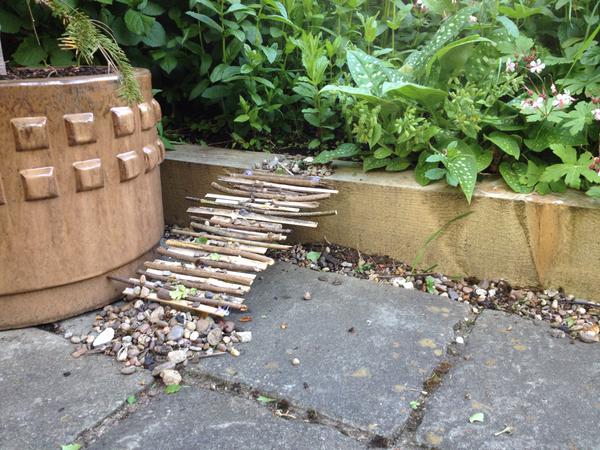
With our garden ponds becoming more ornamental and less wildlife-friendly a hedgehog will inevitably fall in one day. Even though hedgehogs are surprisingly good swimmers they will eventually tire and drown if there's no exit. Hedgehog ramps are also needed for exits off patios at a lower level to the rest of the garden…it's all pretty much common sense! I tend to use a long plank of wood with smaller branches of varying diameters nailed on for grip. They are relatively easy to make and you can even use trees from your own garden to provide the timber!


Here's another version which I have made to allow an exit off our patio. It's almost like a wheelchair ramp. Hogs are not only good swimmers but they are relatively good climbers and could probably get up off the patio easily, but I like to make it more comfortable for them!


Finally, if you ever see a hedgehog out in the daytime the likelihood is that it is underweight and needs help. Ring up either your local animal centre or the Hedgehog Society who can be contacted on 01584 890 801. They will give you advice of what to do next. I hope you have found this blog useful, and will take on some of my tips. Spread the word of the hedgehog decline and get your friends to make their gardens hog-friendly too!

More information about hedgehogs, their threats and how to help them can be found at http://www.hedgehogstreet.org


Friday, 5 June 2015

30 Days Wild - The first 5 days!

So we are already two weeks into #Springwatch 2015, and 5 days into the #30DaysWild Challenge. Time does fly when you're having fun (well, forgetting about my GCSE's that is!) 

Like many of you will know The Wildlife Trusts started a challenge at the beginning of the month: to do something wild every day in June. Even though I do this anyway, I wanted to show my support and join in with the campaign. Rather than just do pointless acts of wildness, I wanted to make sure that the majority of the activities I did had a positive affect on our wildlife, at the same time has having fun! On the 1st day I used foraged mint from our garden to make a cup of herbal tea. Once I had collected the leaves I checked them for any insects before I washed them. The tea was surprisingly nice, even without a heap of sugar! 


For the 2nd day I wanted to do something to help my garden hedgehogs which make regular visits. I already had a hedgehog bridge to get out of the pond, but what about the patio?? If a hedgehog managed to find itself on this lowered area with a high border surrounding it would it be able to get out?? To make sure this never happened I constructed a ramp to allow for easy exiting. I collected branches from the garden and cut them to size. I then nailed them to a small wooden beam, using some hot glue to secure them in place. I attached the ramp to the wooden border and bob's your uncle! In less than 10 minutes I had a fully functional hedgehog escalator!


On the 3rd day I was wondering what to do. After my morning GCSE exam I took a stroll around the campus in the sunshine and got this unusual picture while resting under a tree. It's the unplanned things that can sometimes be the best!


After watching #Springwatch the previous night I though that I should clean out my bird feeders, as dirty ones can spread diseases between the visiting birds (especially greenfinches - they can get a disease called Trichomonosis.) I decided to wash all my feeders in soapy water to hopefully prevent this from happening to any of my local birds. It was quite tricky to clean the inside of the feeder as I couldn't take it apart, but I did my best.  


The 4th day was one the best yet. Whilst in the garden I spotted a semi-circle of small mushrooms in the grass. As I didn't want our dog to eat them (I didn't know if they were edible or not) I collected them and brought them inside. As it's very tricky to get eye-level shots of mushrooms I took the opportunity to set up a macro studio on my kitchen table!

 I got a black cape from our fancy dress box and draped it over a pile of books to create the black backdrop. I then brought in some moss, leaves, soil and flowers from the garden to arrange in the studio. It took quite a while to position them all as I wanted, as when one mushroom fell down it was like dominoes! Eventually I got the magical scene I wanted. Using a LED desk light I got the right lighting…and I was ready to go! First I tried out the macro lens I'm borrowing, but I didn't get the intended affect as it only has a short focal range. I ended up using my 55-250 lens to get the shots I wanted! Not a typically up-close range but it worked.


I spent around 30 minutes snapping away, positioning flowers in different places and moving the light around. Here are just a few of the images to give you a taster of what I captured!


And today, on the 5th day of the #30DaysWild challenge, I cleared out my hedgehog hole to allow for easy access to my wildlife garden. It may look a little precarious with all the relatively heavy slate, but I can assure you, I secured everything really well. I've had the main structure of the hedgehog hole for about a year now and it has worked a treat, with hedgehogs regularly visiting the garden.


In fact my Dad saw one just two days ago, down at the bottom of the garden, at around 10 O'clock while putting the chickens away. They are such great little characters, hence why it's such a shame that they are declining the way they are. If you want to help, do these things: make a hedgehog hole in your fence, wall or hedge to connect our gardens; provide a ramp to get out of your garden pond; if you see one in the daytime put out food and water as daytime-seen hedgehogs are often unweight…and if you really want to push the boat out you can even make a hedgehog box like the one I made below. It doesn't have to be as elaborate…substance over style!


So get outside and get active for nature. Join the #30DaysWild challenge and see what amazing thing you can do for your local wildlife!